
Database Monitoring
The goal of this course is to fully explain DBMS monitoring concepts and approaches, and provide practical knowledge of configuring DBMS monitoring with Zabbix. The course covers various Zabbix native approaches to collect DBMS performance metrics and collect DBMS-related data using Zabbix Agent 2, ODBC and API requests. The course also covers optimizing DBMS data collection by introducing dependent Low-level discovery for minimal DBMS performance impact. During the course, students will practice configuring DBMS monitoring for such DBMS as MySQL, MariaDB, PostgreSQL, MongoDB, Redis, InfluxDB and Elasticsearch.
Information about the course
| Designed for the product: | Zabbix 8.0 |
|---|---|
| Group size: | Up to 10 students |
| Type of exam: | 45 min, theoretical |
| Course prerequisite: | None |
| Level: | Intermediate |
| Course language: | English or Czech — your choice for requested dates |
| Training format: | Online · Hybrid · On-site |
| Course length: | 1 DAY |
| Course price: | 9 900,-€ 420$460 excluding VAT |
Course content
One-day course
- Introduction to various DBMS
- Database monitoring using Zabbix agent 2
- Database monitoring using ODBC
- Additional database monitoring methods
- Encrypting database data collection
- Database monitoring performance considerations
- Database monitoring with bulk data collection

Tomáš Heřmánek
CEO & Zabbix Certified TrainerAdditional information
Certificate
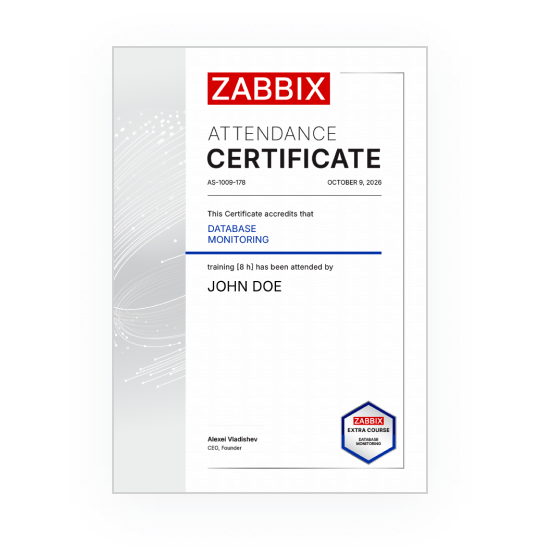
- Each participant receives a certificate of attendance of the Zabbix 8.0 course.
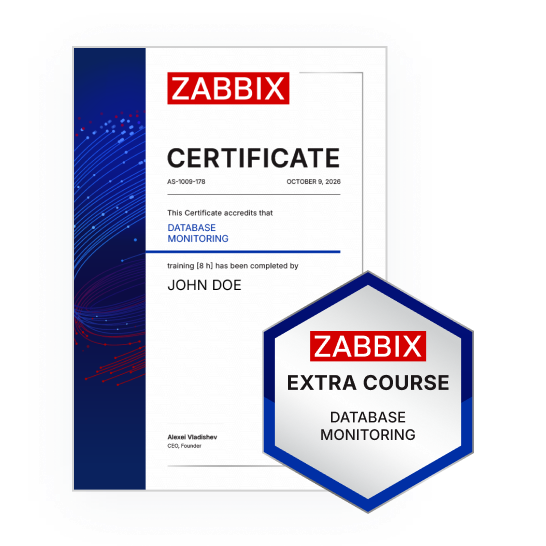
- After successfully passing the exam, you receive: Database Monitoring certificate and digital badge.
- Extra course certificates are issued electronically.

Certificates and gifts for the course
For all attendees
For passing the exam
Acquired skills and knowledge
Automatically discover DBMS performance metrics
Utilize Zabbix low-level discovery features to automatically discover DBMS components.
Collect custom data from both SQL and NoSQL databases
Learn how to utilize various data collection approaches for SQL and NoSQL databases.
Optimize DBMS data collection
Use bulk data collection to reduce the number of database queries and improve data collection performance.
Outcomes
Organizational impact
Databases are an integral part of any IT infrastructure. Databases can be used to store, organize, and manage data for easy access and analysis. Data, which is stored in the databases includes, but is not limited to: Data on sales, orders, and customer service Customer transactions Patient records in healthcare Personal files, including media IT system configuration parameters During this course attendees will learn how to monitor key database metrics and various internal parameters to ensure stable DBMS performance and gain new insights for capacity planning, troubleshooting and more.
Individual impact
By attending this course, attendees will not only familiarize themselves with how monitoring can be extended to various DBMS, but also learn how to automate database metric discovery and optimize DBMS data collection for both technical and business-oriented goals.